E-Course
#ASenseofEU
Discover Europe's Intangible Cultural Heritage through interactive learning, storytelling, community engagement and digital heritage documentation.
Duration
24–30 Hours
Self-paced learning
Modules
8 Learning Modules
Theory & practical activities
Languages
6 Languages
EN • ES • IT • RO • SV • IS
Designed For
Adult Learners;
Educators;
Facilitators;
Community Practitioners
Course Level
Beginner to Intermediate
No prior knowledge required
Format
Open Educational Resource
Online & downloadable
About the Course
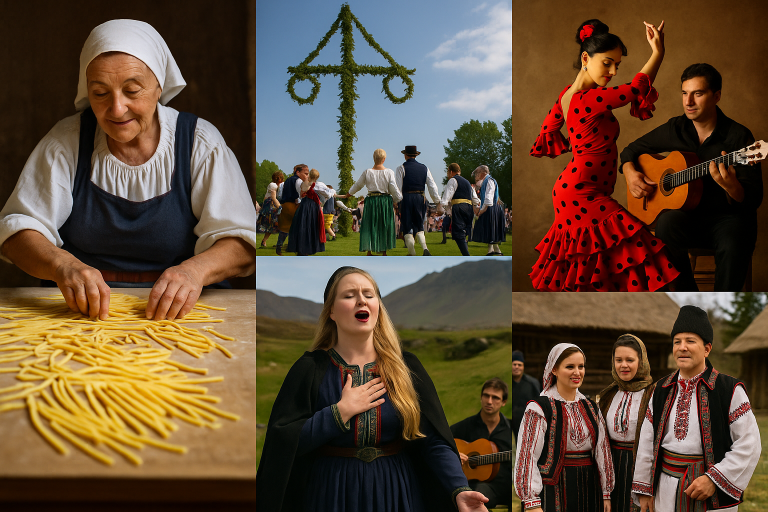
The #ASenseofEU E-Course – Building, Digitising and Exploiting Sense of Place is a free Open Educational Resource (OER) developed within the Erasmus+ KA220-ADU project #ASenseofEU – Empowering Rural Communities to Digitise, Share and Exploit Sense of Place Across Europe Through Intergenerational Exchange.
Based on the Training Modules developed under Work Package 2 (WP2), the course equips learners with the knowledge, practical tools, and methodologies needed to recognise, safeguard, digitise, and promote Intangible Cultural Heritage (ICH) while strengthening the Sense of Place within rural and remote communities.
Developed collaboratively by organisations from Iceland, Italy, Romania, Spain, and Sweden, the course combines research findings, European best practices, and innovative non-formal education methodologies into an engaging and practice-oriented learning experience.
Rather than focusing solely on theoretical knowledge, participants explore real community contexts through practical activities, collaborative exercises, reflection, and the development of a Training Case, allowing them to apply each module to a place from their own community.
Whether you are an educator, community facilitator, cultural practitioner, local authority representative, researcher, or simply passionate about cultural heritage, this course provides practical knowledge and inspiration to help preserve local identity, strengthen community participation, and support sustainable rural development.
What will you learn?
Understand Sense of Place
Discover how places shape identity, belonging, and community life, and explore the relationship between people, places, and cultural heritage.
Digitise Local Heritage
Learn how digital tools can be used to document, preserve, and share stories, traditions, photographs, oral histories, and other forms of Intangible Cultural Heritage.
Safeguard Intangible Cultural Heritage
Learn how traditions, oral histories, customs, craftsmanship, and cultural practices can be identified, documented, and preserved for future generations.
Promote Sustainable Rural Development
Understand how cultural heritage can contribute to community resilience, local identity, social inclusion, and sustainable economic development.
Engage Communities
Explore participatory approaches that encourage collaboration with local communities, stakeholders, and organisations throughout the heritage preservation process.
Foster Intergenerational Learning
Discover methods for connecting generations through the exchange of memories, traditional knowledge, and lived experiences that strengthen community identity.
Create Community Maps
Develop practical skills to identify community assets, cultural resources, and heritage elements through participatory community mapping techniques.
Design Heritage-Based Initiatives
Apply the knowledge and methodologies introduced throughout the course to develop your own community-based heritage or tourism initiative through the Training Case.
Learning Methodologies
The #ASenseofEU Training Module is based on learner-centred and participatory approaches that encourage active engagement, collaboration, and reflection. Rather than relying solely on theoretical knowledge, the course combines practical activities, real-life case studies, and community-based learning experiences that can be directly applied in participants’ own contexts.
Throughout the course, learners gradually develop their own Training Case, applying the concepts explored in each module to design a heritage-based initiative rooted in their local community.
Non-Formal Education
What is Non-Formal Education?
Non-Formal Education (NFE) is a learner-centred educational approach that takes place outside the formal education system. Unlike traditional education, which often follows a fixed curriculum and relies heavily on lectures and examinations, non-formal education focuses on active participation, practical experience, collaboration, and personal development.
In NFE, learners are not passive recipients of information. Instead, they become active contributors to the learning process, sharing their own knowledge, experiences, perspectives, and ideas while learning from others.
Within the #ASenseofEU project, Non-Formal Education provides the pedagogical foundation for the entire training programme. It enables participants to explore Intangible Cultural Heritage, Sense of Place, and community engagement through practical, meaningful, and collaborative learning experiences that can be directly transferred to their own communities.
Key Principles of Non-Formal Education
Learner-Centred
Participants are at the heart of the learning process. Activities are designed around their experiences, interests, needs, and local contexts rather than following a one-way teaching approach.
Learning by Doing
Knowledge is developed through practical activities, experimentation, observation, and direct experience. Participants actively apply concepts rather than simply reading or listening about them.
Voluntary Participation
Non-formal education encourages intrinsic motivation. Participants are invited to contribute actively, share ideas, ask questions, and engage in discussions within a supportive learning environment.
Reflection
Learning does not end when an activity finishes. Reflection is an essential component of NFE, allowing participants to analyse their experiences, identify lessons learned, and consider how they can apply new knowledge in their own contexts.
Collaboration and Peer Learning
Participants learn from one another by exchanging experiences, discussing different perspectives, and working together to solve challenges and develop ideas.
Inclusion and Accessibility
Non-formal education values diversity and promotes equal participation regardless of age, educational background, culture, gender, or professional experience. Activities are designed to be flexible and adaptable to different learning styles and participant needs.
Flexibility
Learning activities can be adapted to different groups, community contexts, learning environments, and participant profiles, making NFE particularly suitable for community development and adult education.
Characteristics of Non-Formal Education in this Course
Throughout the #ASenseofEU E-Course, you will encounter a variety of learner-centred activities designed to encourage participation and practical application, including:
Interactive presentations introducing key concepts
Individual and group reflection exercises
Collaborative discussions and peer learning
Community mapping activities
Storytelling and oral history exercises
Practical case studies and European best practices
Creative problem-solving activities
Digital heritage documentation exercises
Self-assessment and guided reflection
Practical application through the Training Case Methodology
These methods were selected to help participants connect theory with practice while developing knowledge and skills that can be transferred directly to their own communities. The same learner-centred, interactive approach was implemented and validated during the international pilot training mobility in Gubbio, Italy.
The Role of the Facilitator
In Non-Formal Education, the facilitator is not a traditional teacher who simply delivers information.
Instead, the facilitator:
Creates a safe and inclusive learning environment.
Guides discussions rather than providing all the answers.
Encourages participation and collaboration.
Supports reflection and critical thinking.
Helps participants connect learning with real-life experiences.
Adapts activities to the needs and interests of the group.
The facilitator’s role is to enable learning rather than direct it.
Why Non-Formal Education?
The #ASenseofEU consortium selected Non-Formal Education because it is particularly effective for adult learning and community-based heritage initiatives.
By encouraging participation, reflection, collaboration, and experiential learning, NFE helps participants:
develop practical competences alongside theoretical knowledge;
strengthen communication, teamwork, and problem-solving skills;
build stronger connections with their local communities;
recognise and value Intangible Cultural Heritage;
foster intergenerational dialogue and cooperation;
transform learning into concrete community action.
Rather than simply learning about cultural heritage, participants are empowered to actively explore, preserve, and promote the heritage of their own communities.
Experiential Learning
What is Experiential Learning?
Experiential Learning is an educational approach based on the principle that people learn most effectively through direct experience, active participation, and reflection. Rather than simply acquiring theoretical knowledge, learners engage in meaningful activities, analyse their experiences, and apply new insights to real-life situations.
Within the #ASenseofEU E-Course, experiential learning encourages participants to move beyond understanding heritage as a concept by actively exploring, documenting, analysing, and promoting the cultural heritage of their own communities.
Why is it important?
Experiential learning helps learners:
• connect theory with practice
• strengthen critical thinking
• improve problem-solving skills
• increase motivation and engagement
• develop practical competences
• retain knowledge more effectively through real experiences
For heritage education, experiential learning enables participants to understand cultural heritage not only by studying it but by interacting with communities, places, traditions, and local stakeholders.
How is it applied in this course?
Throughout the modules you will:
• analyse real European case studies
• participate in practical exercises
• complete mapping activities
• reflect on your own community
• document local heritage
• create digital heritage resources
• progressively develop your own Training Case
The combination of conceptual learning and practical application reflects the methodology tested during the International Training Mobility in Gubbio, where each day balanced theoretical input with workshops, group discussions, reflection, and field-based learning.
Expected Benefits
After completing the course you will be able to:
✔ apply concepts to real situations
✔ connect learning with your own community
✔ solve practical challenges
✔ develop transferable competences
Place-Based Learning
What is Place-Based Learning?
Place-Based Learning is an educational approach that uses the local environment, culture, history, landscapes, and communities as the starting point for learning. Rather than studying concepts in isolation, participants explore real places that are meaningful to them and investigate how these places shape identity, memories, traditions, and community life.
Within the #ASenseofEU project, Place-Based Learning encourages learners to discover and appreciate the unique characteristics of their own rural or remote communities while recognising the importance of local heritage as a driver of sustainable development and community wellbeing.
Why is it important?
Places are more than physical locations—they are shaped by stories, traditions, memories, relationships, and cultural practices. Understanding these connections helps communities recognise the value of their local heritage and strengthens their Sense of Place.
By learning directly from their own surroundings, participants develop a deeper understanding of local identity while becoming more engaged in safeguarding and promoting their cultural heritage.
How is it applied in this course?
Throughout the course you will:
Explore a rural or remote place from your own context.
Identify elements that contribute to its unique identity.
Analyse local traditions, customs, and cultural practices.
Reflect on the relationship between people and place.
Connect local heritage with community wellbeing and sustainable development.
Use your selected place as the foundation for your Training Case.
Expected Benefits
By applying Place-Based Learning, participants will:
Develop a stronger understanding of local identity.
Recognise the value of community heritage.
Connect learning with real places and experiences.
Strengthen their Sense of Place.
Identify opportunities for heritage-based community initiatives.
Community-Based Learning
What is Community-Based Learning?
Community-Based Learning is an educational approach that places communities at the centre of the learning process. It encourages participants to actively engage with local people, organisations, cultural practitioners, and stakeholders in order to understand, document, safeguard, and promote the cultural heritage that exists within their own communities.
Rather than viewing communities simply as beneficiaries of educational activities, this approach recognises them as active partners and knowledge holders. Local experiences, traditions, memories, and cultural practices become valuable learning resources that enrich both the educational process and community development.
Within the #ASenseofEU project, Community-Based Learning supports participants in exploring how community participation can strengthen local identity, encourage social inclusion, and contribute to the sustainable safeguarding and promotion of Intangible Cultural Heritage (ICH).
Why is it important?
Intangible Cultural Heritage exists because communities create it, practise it, preserve it, and transmit it from one generation to the next. Without active community participation, many traditions, stories, crafts, celebrations, and local practices risk disappearing.
Community-Based Learning empowers participants to work with communities rather than for communities, ensuring that heritage initiatives reflect local needs, values, and aspirations. It also strengthens trust, collaboration, and shared ownership, making heritage preservation a collective responsibility.
How is it applied in this course?
Throughout the course, participants will:
Identify and engage relevant community stakeholders.
Explore local needs, challenges, and opportunities.
Learn participatory approaches to community engagement.
Collaborate with community members to identify elements of Intangible Cultural Heritage.
Apply community mapping techniques to identify cultural assets.
Design heritage initiatives that respond to local priorities and encourage active participation.
The practical activities encourage learners to connect with their own communities while recognising that meaningful heritage preservation can only be achieved through active local involvement.
Expected Benefits
By completing this course, participants will be able to:
Apply participatory approaches within community settings.
Build stronger relationships with local stakeholders.
Facilitate community engagement processes.
Promote inclusive participation in heritage initiatives.
Design community-centred projects that strengthen local identity and social cohesion.
Intergenerational Learning
What is Intergenerational Learning?
Intergenerational Learning is an educational approach that promotes meaningful interaction, cooperation, and mutual learning between people of different generations. It recognises that every generation possesses valuable knowledge, experiences, memories, skills, and perspectives that contribute to the understanding and preservation of cultural heritage.
Within the #ASenseofEU project, Intergenerational Learning plays a central role in safeguarding Intangible Cultural Heritage by encouraging the exchange of local knowledge, traditions, stories, and cultural practices between younger and older generations.
Why is it important?
Many forms of Intangible Cultural Heritage survive because they are transmitted informally through families, communities, and everyday life. Older generations often act as custodians of local memories and traditions, while younger generations contribute new ideas, digital competences, and innovative ways of preserving and sharing heritage.
Bringing generations together strengthens community cohesion, encourages mutual respect, and ensures that valuable cultural knowledge continues to be shared and appreciated.
How is it applied in this course?
Throughout the course, participants will:
Explore methods for facilitating dialogue between generations.
Collect oral histories and personal memories.
Document traditional knowledge and community stories.
Encourage collaborative activities involving participants of different ages.
Reflect on the importance of knowledge transfer within communities.
Integrate intergenerational perspectives into their own Training Case.
These activities demonstrate how collaboration between generations can support the preservation, documentation, and promotion of local heritage.
Expected Benefits
By completing this course, participants will be able to:
Facilitate intergenerational learning activities.
Encourage knowledge exchange between generations.
Preserve local memories and traditions.
Strengthen community relationships and social inclusion.
Integrate intergenerational approaches into heritage and community projects.
Reflective Learning
What is Reflective Learning?
Reflective Learning is a continuous process of analysing experiences, evaluating learning, and considering how new knowledge can be applied in practice. It encourages participants to think critically about what they have learned, how they learned it, and how this knowledge relates to their own communities and professional practice.
Reflection transforms experience into meaningful learning by helping participants recognise connections between theory, practice, and personal experience.
Why is it important?
Learning becomes more effective when participants have the opportunity to pause, analyse their experiences, and identify new perspectives.
Reflection encourages critical thinking, supports continuous improvement, and helps learners understand how they can transfer newly acquired knowledge and competences to real-life community contexts.
Within the #ASenseofEU project, reflective learning supports participants in connecting heritage concepts with their own local realities while strengthening their capacity to design meaningful community initiatives.
How is it applied in this course?
Reflection is integrated throughout every module through:
Guided reflection questions.
Individual learning journals.
Group discussions and debriefing sessions.
Self-assessment activities.
Reflection following practical exercises.
Continuous reflection on the development of the Training Case.
Participants are encouraged to revisit their ideas throughout the course, allowing their projects to evolve as their understanding deepens.
Expected Benefits
By completing this course, participants will be able to:
Critically analyse their own learning experiences.
Connect theoretical knowledge with practical application.
Improve decision-making and problem-solving skills.
Strengthen self-awareness and professional development.
Continuously improve community-based heritage initiatives.
Training Case Methodology
What is the Training Case Methodology?
The Training Case Methodology is the distinctive pedagogical approach of the #ASenseofEU Training Programme. Rather than treating each module as an independent learning experience, participants work progressively on a single practical project inspired by a rural or remote place from their own local context.
Throughout the course, every module contributes new knowledge, tools, and practical activities that are directly applied to this Training Case. As participants progress, they gradually develop a heritage-based initiative that reflects the identity, cultural heritage, and aspirations of their chosen community.
Why is it important?
The Training Case Methodology enables participants to immediately apply theoretical concepts in a meaningful and realistic context.
Instead of completing isolated exercises, learners continuously build upon the same project, strengthening their understanding of how Sense of Place, Intangible Cultural Heritage, community engagement, intergenerational learning, digitalisation, and sustainable rural development are interconnected.
This approach bridges the gap between theory and practice while encouraging creativity, critical thinking, collaboration, and long-term community impact.
How is it applied in this course?
Throughout the learning journey, participants progressively develop their Training Case by:
Selecting a rural or remote place from their own community.
Exploring its Sense of Place and community identity.
Identifying elements of Intangible Cultural Heritage.
Engaging local stakeholders and community members.
Applying Community Mapping techniques.
Exploring opportunities for digital heritage documentation.
Designing a heritage- or tourism-based initiative inspired by local identity.
Presenting and reflecting on their final project.
Each module contributes directly to the development of the Training Case, allowing participants to integrate the knowledge and skills acquired throughout the course into one coherent and practical community initiative.
Expected Benefits
By completing this course, participants will be able to:
Apply every module to a real community context.
Design practical heritage-based initiatives.
Strengthen project planning and facilitation skills.
Integrate participatory and community-centred approaches into their work.
Produce a realistic project that can continue to evolve beyond the course and contribute to the sustainable development and promotion of local cultural heritage.
Learning Modules
Module 1
Introduction
&
Group Building
Getting started with the course, project objectives, and learning expectations.
Module 2
Sense of Place
Understanding identity, belonging, memory, and local landscapes.
Module 3
Intangible Cultural Heritage
Exploring traditions, practices, stories, and living heritage.
Module 4
Intergenerational Learning
Connecting generations through knowledge exchange and community engagement.
Module 5
Community Mapping
Participatory methods for identifying local assets and heritage resources.
Module 7
Rural ICH-Based Tourism Development
Creating sustainable tourism experiences rooted in local identity.
Module 8
Summary, Evaluation & Presentation
Celebrate your learning journey by presenting your ICH-based tourism product.
Downloadable Resources
Prefer an offline version? Download the complete Training Modules in PDF format below.
Training Modules – 🇬🇧 English Version
Download the complete Training Modules in English
🇬🇧 (PDF)
Training Modules – 🇪🇸 Spanish Version
Download the complete Training Modules in Spanish
🇪🇸 (PDF)
Developed by