Reflecting on Sustainable Heritage-Based Tourism – Granada Heritage Lab
Description:
This activity was developed within the Intangible Cultural Heritage-Based Tourism Heritage Lab of the #ASenseofEU project in Granada, Spain.
The Heritage Lab explored how local traditions, cultural practices, stories and community knowledge can contribute to the development of responsible tourism experiences while preserving the cultural identity of local communities.
Following the exploration and development of heritage-based tourism concepts, participants were encouraged to reflect on the importance of cultural authenticity, community participation and the potential benefits and challenges of tourism initiatives.
The activity highlighted how tourism experiences should respect the cultural meaning of local traditions and contribute positively to the communities that preserve them.
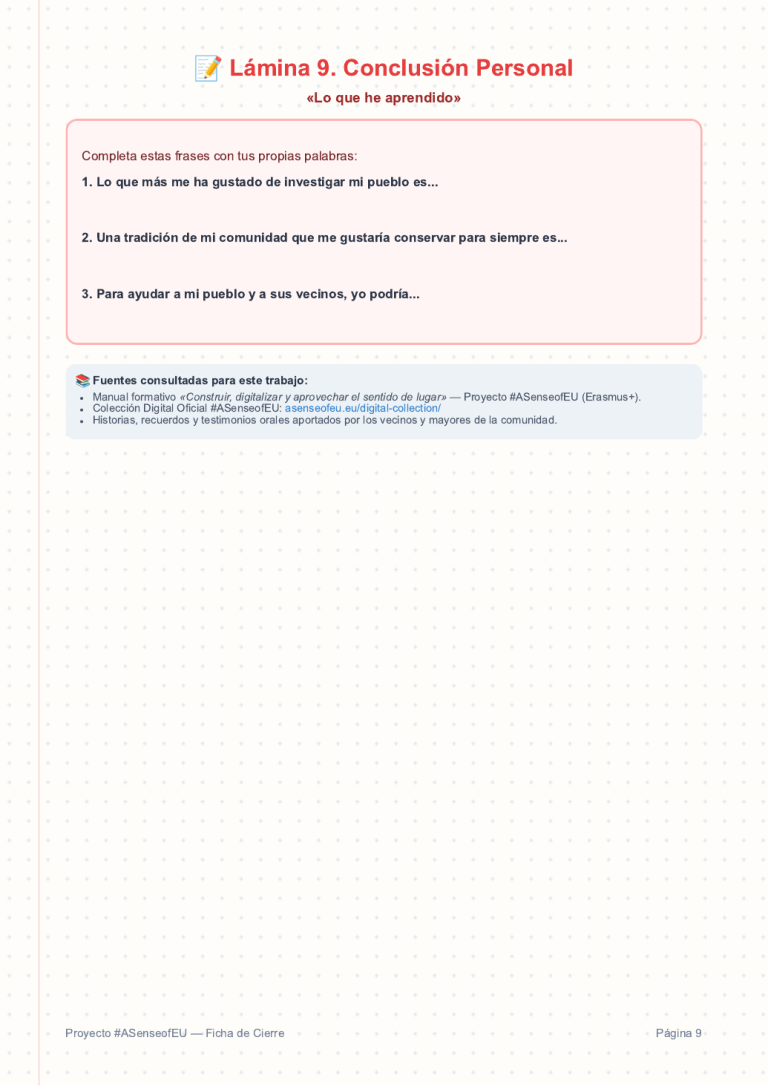
The accompanying educational material, “Conclusión Personal” (Personal Reflection), encourages participants to consider what they have learned about their local heritage, the importance of preserving traditions and their potential role in safeguarding cultural knowledge for future generations.
What do participants do in the activity?
- Reflect on the cultural heritage explored during the Heritage Lab.
- Share perspectives on the importance of preserving local traditions.
- Discuss the potential benefits of heritage-based tourism for local communities.
- Consider challenges related to cultural authenticity and commercialisation.
- Reflect on the role of community members in safeguarding cultural heritage.
- Identify possible actions for preserving and sharing local traditions.
What do participants learn?
Participants learn how to:
- Reflect critically on the relationship between cultural heritage and tourism.
- Recognise the importance of cultural authenticity and community ownership.
- Understand the potential benefits and risks of heritage-based tourism.
- Appreciate the role of local communities in preserving traditions.
- Identify opportunities for sustainable and responsible tourism development.
- Recognise their own role in safeguarding Intangible Cultural Heritage.
Gallery
This worksheet encourages reflection on local traditions, cultural identity, intergenerational learning and the importance of safeguarding cultural heritage.